Showing posts with label Brutal. Show all posts

Monday, 15 August 2022

10 Minutes 38 Seconds in This Strange World - Elif Shafak

"For Leila, each minute after her death brings a sensuous memory: the
taste of spiced goat stew, sacrificed by her father to celebrate the long-awaited birth of a son; the sight of bubbling vats of lemon and sugar which the women use to wax their legs while the men attend mosque; the scent of cardamom coffee that Leila shares with a handsome student in the brothel where she works. Each memory, too, recalls the friends she made at each key moment in her life - friends who are now desperately trying to find her. . ."

10 Minutes is separated into two parts, the Mind, with Leila recalling the moments of her life and The Body, the efforts of her friends to recover and bury her. Right there, in that two-part structure is something startlingly radical: Leila is both a mind and a body, a fully rounded woman with four decades of lived experience and a cadaver on a medical examiner’s table. Her death is not where the story ends or where it begins. Her grisly murder is not an outrage to be avenged, nor a puzzle to be solved , there is no brilliant/jaded/antisocial detective , it is simply a tragedy. A lurid death of the type so common in fiction (and upon which a whole genre has been built) – a murdered whore stuffed into a bin – but here the victim is humanised, centred, she is no plot device in someone else’s story.

It is a deeply depressing story of exclusion, sexual abuse, the fall into prostitution, the death of loved ones and an all encompassing feeling of abandonment and hopelessness. But that is not all it is. Yes, there is incredible sadness. But there is also hope, and friendship, and love. For me this book re-affirms how very special life it. What it means to be alive. How and why we can try to make changes and make the world more inclusive and loving.  Most importantly to seek out those with which you will be able to share your life with, those who are meaningful and understand you. 

Shafak's sensual writing abounds. You can smell the scents of spices, cardamom, lemon. You can feel the heat from the sky. The evening breeze on your neck. The lights of the city at night. The sizzle of the food vendor's grill. See the sun reflecting off the harbour. Hear the seagulls careening. The writing is so wonderfully descriptive. 

This is not a perfect novel by any stretch. Leila’s life story is compelling, but not remarkably so; Shafak’s prose style is undeniably lush and sensual, but also occasionally sentimental. Two consecutive chapters open with almost identical lines, which felt slightly lazy. Leila’s ‘found family’ of misfits are drawn with broad brushstrokes and feel more like ‘types’ than real people and their farcical efforts in Part Two are a bit slapstick (Part Two is overall weaker than Part One). 

But along with the mawkishness and melodrama there is poignant charm , wisdom, beauty and compassion. 10 Minutes 38 Seconds in This Strange World is a novel that beguiles and seduces despite its flaws.

Age Rating 18+. Sexual abuse of a minor, prostitution, swearing, murder, serious mental illness. 

Tuesday, 2 August 2022

Parable of the Sower - Octavia E. Butler

"In 2025, with the world descending into madness and anarchy, one
woman begins a fateful journey toward a better future.

Lauren Olamina and her family live in one of the only safe neighbourhoods remaining on the outskirts of Los Angeles. Behind the walls of their defended enclave, Lauren’s father, a preacher, and a handful of other citizens try to salvage what remains of a culture that has been destroyed by drugs, disease, war, and chronic water shortages. While her father tries to lead people on the righteous path, Lauren struggles with hyperempathy, a condition that makes her extraordinarily sensitive to the pain of others.

When fire destroys their compound, Lauren must make her way north to safety, along the way conceiving a revolutionary idea that may mean salvation for all mankind."

I have mixed feelings about this book. On one hand it's a good dystopian novel. It speaks to the reality of religion as a socially unifying force, as a tool to necessitate movement and cohesion. It has a interesting group of characters and a plot that is interesting and moves at a good pace. It has the usual brutality of dystopian, rape, killing and arson being present on almost every page, but that is par for the course in the genre. I enjoyed my experience reading it. 

But unfortunately Butler's insights into religions aren't revolutionary. The rag tag group of survivors that meet on the road to form a found family it tried, tested and a little tired. The effects of the hyper empathy on Lauren are disappointingly little. Lauren, the narrator of the story, is painfully unemotional both in her actions and her narration style. I think this was possibly to show how quickly we become desensitised to violence in a survival situation. But that doesn't explain why Lauren was so unemotional in the beginning, surrounded by a community and loving family. I also didn't understand her attraction to the older man. I mean he was like 50 and she was a teenager. That just felt creepy and gross, sorry. 

I am confused about the choice of cover design. This cover doesn't make it obvious it is a dystopian set in the future. It also really over plays the race aspect which isn't a huge themes of the book, except some offhand mentions. 

Overall it was a good dystopian, but it didn't stand out to me. I obviously cant speak to it's impact or originality during its first publishing. However, now, it didn't have much new to offer me. 

Age Rating 18+. Brutal. Rape, arson, murder, drugs, cannibalism. 


Monday, 25 July 2022

Another Country - James Baldwin

"Set in Greenwich Village, Harlem, and France, among other locales,
Another Country is a novel of passions--sexual, racial, political, artistic--that is stunning for its emotional intensity and haunting sensuality, depicting men and women, blacks and whites, stripped of their masks of gender and race by love and hatred at the most elemental and sublime."

It would be overly simplistic to say that this book is about racism. It is, in a way. But it is more broadly a book about human struggle. The struggle against the many manifold issues, pains and inner turmoil that plague the everyday human. It's about people trying to make it work and still getting it all wrong. And that's interesting, no? For a book that came out in 1962, Baldwin is unabashed and runs the whole gamut of human interaction. It is sweet, scary, idealistic, depressing, nostalgic, and sometimes downright ugly. But it's also not overblown or politicized. It never feels like it trying to make a point or tell a lesson. Baldwin is merely showing us humans, dirty, ugly, striving, beautiful humans in all their complexity. A complexity that is often inextricably linked with the social environment around them. 

It is an undeniably sensual book, as all Baldwin's work is to a point. His characteristic style of eloquent brutality and raw sensuality are at once erotic and haunting, each increasing the impact of the other. For me, the main take away of this book was the understanding of the raw sexuality of the human experience. To strip us right back, to take away race, sexuality, gender, class, all we want is to be seen, wanted and needed. That is the basic human need and to deprive us of that is to create monsters of us. 

A deeply impactful book. I cannot recommend it enough though it is at times a tough read. 

Age Rating 17+ Domestic abuse, rape, sexual content, hate crimes, suicide, depression, alcoholism. 

Monday, 14 February 2022

By Light Alone - Adam Roberts

"In a world where we have been genetically engineered so that we can
photosynthesise sunlight with our hair hunger is a thing of the past, food an indulgence. The poor grow their hair, the rich affect baldness and flaunt their wealth by still eating. But other hungers remain...

The young daughter of an affluent New York family is kidnapped. The ransom demands are refused. Years later a young women arrives at the family home claiming to be their long lost daughter. She has changed so much, she has lived on light, can anyone be sure that she has come home?"

I was drawn to this book initially by the very interesting premise. I am also willing to admit, here and now, that the cover totally sucked me in. An art deco sensibility is definitely the way to make me interested in starting your book.

The main idea is that science has produced a mechanism where people are able to gain all their energy from sunlight, thanks to a bug that makes their hair capable of photosynthesis. All they need to live is water and a few essential nutrients. A clever idea, certainly, but where Roberts triumphs is in exploring the many unexpected implications of this change. The absolute heart of what makes science fiction. 

One implication considered is that for the first time ever it's possible to have a group of people who have literary no money at all.(Besides slaves obviously.) A group of people that the wealthy can argue don't need to be paid in money. Making them not just poor, but literally penniless. Roberts also examines the possibilities for male/female distinctions (though I will be honest this sounded extremely far fetched), and how a small group of wealthy people might consider those who have the special hair to be a subspecies, and begin to conspicuously wear their hair short to emphasise their extreme wealth. 

Something I thought was clever on Roberts part is that he creates a world in which the wealthy and the poor both realistically portray their stereotypical attributes. The poor sit around all day doing nothing, lazy, sex obsessed, violent, contributing nothing. But for reasons that make sense in the world. The poor, because they are surviving on light alone, have no extra energy to do anything. They survive but are skeletal and easily drained, fighting for the one resource they still need. Water. 

The wealthy, on the other hand, are cut off from reality, selfish and wasteful. They literally make the labouring forces into skeletons and rob them of the ability, literally and metaphorically, to eat. 

The book is divided into four parts, each seen from a different (but linked) individual's point of view. At the heart of the book is the story of a privileged family whose daughter is taken from them on a skiing holiday. They assume initially she has been taken as a hostage, but the authorities gradually explain that something much darker is behind it.

The one fault I would say that the book has is that the forth segment, which is the longest, seen from the viewpoint of the captured daughter, is the least effective. It's partly because the environment she is in forces a slow, plodding development, with occasional dramatic outbreaks of violence and rape, but also because it just doesn't work quite as well as the other sections. I am not quite sure why this is. It's undeniably good, but the others are brilliant. Strangely I absolutely adored the Mother's Chapter. Roberts excels at creating a unique inner voice with each POV, something that many authors struggle with. The mother's internal monologue is so inherently selfish and manipulative. Full of privilege, victim complexes and entitlement. But she is blind to it. We as the readers, not only see her for what she is, but are also made to see the world through her warped eyes and are brough to understand how horrific people can genuinely believe themselves to be good people. Roberts makes use of much of today therapy/self help speech, parroting wealthy celebs self love talk making this character instantly recognisable and all the more horrifying. 

I would also like to point out how wonderful Roberts prose is. There aren't many sci-fi authors that employ such poetic and startlingly beautiful writing. Though it was rambling at points, it actually felt coherent in the world. A boredom in the parent's chapters as they ramble on with no real reason for existence due to their wealth, nothing to strive for. And a surrealist introspection caused by deep trauma in the daughter. 

Age Rating 18+. Violence, death, murder, rape, paedophilia, kidnapping, assault. 

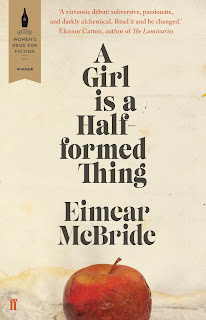
A Girl is a Half Formed Thing - Eimear McBride

"Eimear McBride's debut tells, with astonishing insight and in brutal
detail, the story of a young woman's relationship with her brother, and the long shadow cast by his childhood brain tumour. Not so much a stream of consciousness, as an unconscious railing against a life that makes little sense, and a shocking and intimate insight into the thoughts, feelings and chaotic sexuality of a vulnerable and isolated protagonist. To read 
A Girl Is A Half-Formed Thing is to plunge inside its narrator's head, experiencing her world first-hand. This isn't always comfortable - but it is always a revelation."

I don't often review a book that I have stopped reading because I don't feel that I have a full view to accurately critic the piece of work, but I had to speak about this book. 

The content was something that I was truly interested in reading about and experiencing. A conflagration of pain, sexuality, abuse, trauma, religion and growing up. All themes right up my alley. I also appreciate authors experimenting with new styles of fiction, prose and testing the limits of literature. Without experimentation we cant progress. Despite what it might seem like in some other of my reviews, I appreciate every book that an author writes no matter how much I dislike it. Writing is difficult and we all have something unique to bring to the literary table. 

And this book is incredibly unique. So unique that I actually couldn't finish reading it due to the almost impossibility of comprehension. You either let this strange novel teach you how to read it, going right back to Primary School, and grow accustomed to its impressionistic voice, or you suffer through what feels like a migraine in print. I actually felt like I was having a stroke while reading this. I’m not convinced that pride of endurance is sufficient reward for completing. I might re try reading this book at some point as there where some paragraphs that where incredibly and poetically raw. McBride's epileptic prose style might actually be better suited to describing the depths of trauma then neatly constructed paragraphs. 

Age Rating 18+. Incredibly adult themes such as rape, incest, abuse, mental illness and more. 

Candide - Voltaire

"Candide is the story of a gentle man who, though pummeled and slapped in every direction by fate, clings desperately to the belief that he lives in "the best of all possible worlds." On the surface a witty, bantering tale, this eighteenth-century classic is actually a savage, satiric thrust at the philosophical optimism that proclaims that all disaster and human suffering is part of a benevolent cosmic plan. Fast, funny, often outrageous, the French philosopher's immortal narrative takes Candide around the world to discover that -- contrary to the teachings of his distinguished tutor Dr. Pangloss -- all is not always for the best."

I wasn't quite sure what I was getting into when I picked up this book, with little understanding of Voltaire's philosophy or the plot of Candide. So you can imagine my surprise at the contents of this wonderful and horrifying little satire which might shape up to be one of my favourite books. 

Voltaire's novel introduces the reader to Candide, a wide-eyed, calm and amusingly bland young gentleman who resides at Castle Westphalia and who believes in the philosophy that "everything in the world is for the best." One of the first scenes is filled with two emotional opposites for Candide who first gets to kiss his love, Cunegonde behind a screen, only to then be kicked out of the castle, literally, by the Baron of Thunder-ten-Tronckh.

Here begins Candide's incredible, fantastical adventure which takes him all over the globe with his mind always believing in "the folly of optimism". Moving on from being a soldier in the Bulgarian army to being shipwrecked, being involved with the aftermath of an earthquake, discovering then leaving the mythical El Dorado, to being robbed and swindled more times than seems fair - our hero has a lot of bad luck. One of the overarching issues of this narrative is to present that it isn't just Candide that bad things happen to and that the world is just pretty damn horrible. Tragic things happen to all our main characters including philosopher Dr. Pangloss, Candide's love Cunegonde, and a nice old lady who saved Candide from certain death. The tale is humorously and satirically presented in short, sharp chapters by Voltaire. Most descriptions of doom and degradation are presented in a highly comic fashion which not only serves to allow the reader to continue reading with less emotional scarring but also highlights the stupidity/horror of optimism and a "positive outlook" in these kinds of situations. Though somehow there where scenes that where just so horrific yet comically absurd that I couldn't help but laugh. 

The heartlessness, negativity, and cold-heartedness of humans is a frequent aura and undertone throughout. The novel features all sorts of nastiness such as rape, murder, torture, prostitution, robbery, and slavery among other nastiness and nonsense. 

The whole cast is, strangely, relatable and likable with each being a symbolic caricature of some aspect of ourselves. Some of the times they meet up with friends spontaneously all over the world is amazingly far fetched and draw attention to the satirical character of the story, allowing the characters to compare experiences, hardships, and evolving outlooks. Two of the main characters are the optimistic philosopher Dr. Pangloss and ultimately pessimistic scholar and travel companion of Candide's, Martin. The juxtaposition here is very interesting, with a "black and white"  of these two view points.

I loved the way that the book ends. I wont spoil it too much, but it was just perfect. The group of lost souls finding a unity in tending and being surrounded by nature and enjoying their own creative hobbies. The difference of outlook being forgotten in the coming together to live as good a life as they are going to get. The ending was surprisingly hopeful, at least to me, for such a horrifying story. You will not be able to avoid suffering as it is a part of life and complete optimism is a stupid outlook with so much pain in the world, however you can still find a life where you can, if not overcome you trauma, at least live with it. 

The story reminded me somewhat of the Journey of Buddha before he becomes the Buddha where the naïve and sheltered Indian Prince first ventures out and encounters all of the suffering in the world. I don't know whether this was intentional on Voltaire's part but it was an interesting thing to note. 

Age Rating 18+. As stated above this book contains every level of awfulness possible and doesn't shy away from it. 

Thursday, 28 October 2021

Now I Rise (#2) - Kiersten White

"She has no allies. No throne. All she has is what she’s always had:
herself.


After failing to secure the Wallachian throne, Lada Dracul is out to punish anyone who dares to cross her blood-strewn path. Filled with a white-hot rage, she storms the countryside with her men, accompanied by her childhood friend Bogdan, terrorizing the land. But brute force isn’t getting Lada what she wants. And thinking of Mehmed brings little comfort to her thorny heart. There’s no time to wonder whether he still thinks about her, even loves her. She left him before he could leave her.

What Lada needs is her younger brother Radu’s subtlety and skill. But Mehmed has sent him to Constantinople—and it’s no diplomatic mission. Mehmed wants control of the city, and Radu has earned an unwanted place as a double-crossing spy behind enemy lines. Radu longs for his sister’s fierce confidence—but for the first time in his life, he rejects her unexpected plea for help. Torn between loyalties to faith, to the Ottomans, and to Mehmed, he knows he owes Lada nothing. If she dies, he could never forgive himself—but if he fails in Constantinople, will Mehmed ever forgive him?

As nations fall around them, the Dracul siblings must decide: what will they sacrifice to fulfil their destinies? Empires will topple, thrones will be won…and souls will be lost."

I just love this series and it's reimagining of Vlad the Impaler as a woman called Lada. I love that Lada is allowed to be every bit as mean and bloodthirsty as Vlad, but also, somehow, demand sympathy from the reader. Well, from me anyway. She stands out as one of my favourite characters from all the YA series I've read in recent years. 

This book is - in short - about the fall of Constantinople and Lada's reclamation of Wallachia (you should read the actual history of this, if you're unfamiliar; it is fascinating). It is split into two stories that rarely meet, but both are extremely exciting and compelling.

And I Darken was a well-written and developed book, but I had mixed feelings on the romance and wanted a bit more in the character department. I did not expect either aspect to improve. I definitely did not expect White to fix BOTH of my issues with book one. It's not often a sequel can surpass my expectations so much, but this sequel is undeniably better than book one. Now I Rise both does away with the love triangle drama and far surpasses book one in terms of character work.

Lada doesn't get any less fierce during this book; in fact, she gets even more brutal. Yet she's not completely heartless; she has some very compelling relationship development with several side characters. While she just doesn't have as far to go in terms of development, I still enjoyed her journey and conflict over duty to family.

Then there's Radu, who I didn't particularly care for in the first book. Here, though, he got an incredible character arc. I am still reeling from this character arc. I cannot get over how much Radu has grown and changed. Radu's inner debate over which side truly deserves to win Constantinople really stands out throughout the book, in both his internal and external conflict. It's incredibly difficult to write characters on both sides of the fence, but White executed it brilliantly.

White's writing, while brilliant in the first book, also feels like it has matured. There where so many stunning description. The dialogue feel natural yet poetic. None of these side characters are one-dimensional. Even my least favourite side characters never felt like plot devices but rather fully fleshed out people that demonstrated different ways this war effects people; they're all morally ambiguous and they're all interesting. I must also call out White's brilliant way of writing about difficult topics. All the themes about religion and its role are brought up with delicacy and respect, yet never comes off as didactic or preachy. This series is so good at discussing religion in a non-offensive way.

The queer rep and dismantling internalised misogyny was brought through from the first book. Lada fighting to discover her own way of being a women, Radu feeling like an outsider and constantly unworthy of affection where all handled brilliantly. While this series is technically a YA it feels so much darker, brutal and complex. 

Age Rating 16+ Sex, death, war, murder. 

Monday, 16 August 2021

Morning Star - Peirce Brown

"Darrow would have lived in peace, but his enemies brought him war.
The Gold overlords demanded his obedience, hanged his wife, and enslaved his people. But Darrow is determined to fight back. Risking everything to transform himself and breach Gold society, Darrow has battled to survive the cutthroat rivalries that breed Society’s mightiest warriors, climbed the ranks, and waited patiently to unleash the revolution that will tear the hierarchy apart from within.

Finally, the time has come.

But devotion to honour and hunger for vengeance run deep on both sides. Darrow and his comrades-in-arms face powerful enemies without scruple or mercy. Among them are some Darrow once considered friends. To win, Darrow will need to inspire those shackled in darkness to break their chains, unmake the world their cruel masters have built, and claim a destiny too long denied—and too glorious to surrender."

A truly brilliant ending to a wonderful series. 

Not only is the series very well-written, but it has a lot more complexity than I'd originally expected. Both in the characters, the plot, and in its morality and, personally, I'm a huge fan of complexity.

The other thing that really stands out is the fact that the books are wildly unpredictable without being irritating or disappointing. I'm pretty good at anticipating where a story is going to go, and these books constantly zigged when I expected them to zag. But (and this is a really important note) while the ziggs the book took were surprising, they were always sensible and fit smoothly into the overall narrative and world.

The plot remains true to the direction from Golden Son, which means it’s still done within the large scale genre of Sci-Fi and Space Opera, compared to Red Rising which was Sci-Fi & Dystopia. The pacing of Morning Star is a bit slower this time and I honestly prefer the pacing of Golden Son. However, it’s understandable, after the rollercoaster that happened in Golden Son plus with everything built up from the first book, it’s obvious that there are a lot to settle in the last book to close the story and that results in slower pacing compared to its predecessor.

Darrow and Sevro remain my favourite characters for the whole series, I find their friendship an absolute pleasure to read and it’s really clear how much Brown dives into the theme of friendship and its importance in this book. The wide variety of characters, their development, and their stories are delightful to read. Darrow was 16 years old in Red Rising and he's 23 in Morning Star, the whole story took 7 years and you bet there's a lot of developments happening to all the characters.

However, Brown is not afraid to kill off his characters if necessary and I personally find that a really great trait every story writer should have, not only in books but in all form of medium. But, once again, despite all the fear and pain and heartbreak, Brown proves himself a dab hand at balancing pain with humor creating some truly laugh out loud moments. 

The writing remained impeccable since the beginning until the end. Poignant, poetic, dark, full of love, humor, beauty, rage, violence, hatred, etc. These made every scene vivid and relatable plus the epic climax sequences were vivid and dramatic. One of my favourite parts of this trilogy is Brown's focus on morality, consequences and values. What it important to you, how much are you willing to sacrifice for those values, are you willing to save people if it costs you your moral high ground? All of these ideas are navigated with skill and subtly by Brown. 

Age Rating 17+ It’s completely geared toward adults and everything in it is written like one, it contained a lot of harsh language, gory scenes, torture, murder and it only gets darker as the series progressed. The story is dark, there are also hints of rape and cannibalism throughout the series. 

Everything Under - Daisy Johnson

"The dictionary doesn’t contain every word. Gretel, a lexicographer
by trade, knows this better than most. She grew up on a houseboat with her mother, wandering the canals of Oxford and speaking a private language of their own invention. Her mother disappeared when Gretel was a teen, abandoning her to foster care, and Gretel has tried to move on, spending her days updating dictionary entries.

One phone call from her mother is all it takes for the past to come rushing back. To find her, Gretel will have to recover buried memories of her final, fateful winter on the canals. A runaway boy had found community and shelter with them, and all three were haunted by their past and stalked by an ominous creature lurking in the canal: the bonak. Everything and nothing at once, the bonak was Gretel’s name for the thing she feared most. And now that she’s searching for her mother, she’ll have to face it."

A truly haunting book. Something that sits with you for weeks after you have read it. 

Johnson creates a unique tale, channelling an ancient Greek tragedy, in a voice that is almost unbearable raw at times. Full of a strong symbolism, it is a novel that defies genres and labels. At the heart of the story is the relationship between mothers and daughters. A very particular, very difficult relationship, a bond that is unbreakable, a bond that, more often than not, goes horribly wrong, especially with a mother like Sarah. It is an exploration of a highly problematic childhood, a time of threat, of the moments when the roles of the mother and the child are reversed. The lack of clarity is central to the development of the story. Johnson's prose weaves and loops, hauntingly vague and allusive at times, and painfully and bluntly raw at others. Truly a writer to be watched. 

Told in 1st person through Gretel and in 3rd person through Marcus, words become jumbled, conveying cryptic messages that takes on all of the aspects of a non-disneyfied Grimm fairy-tale. As Sarah is struggling with dementia, there is an extreme confusion of words and intentions and communication is lacking. It is not accidental that Gretel is a lexicographer working on a dictionary and that she and her mother had invented a language of their own. There is also a focus on riddles, often without any provided answers and each character while being fully realised also feels recognisable to traditional fairy-tale tropes. I really enjoyed the representation of trans people, it just felt natural and unforced.

As someone who lives around Oxford it was wonderful to see my city being displayed with such wonderful literary aplomb and the creepiness only fitting the abandoned water pathways in autumn. 

Johnson weaves a tale that is impeccably rich. Piece after piece of the puzzle is discovered under layers of unspoken words and untold stories until you are slapped in the face with a plot twist that you where desperately hoping wasn't the case. We often say that one has to read a book in order to understand it. This phrase finds its true meaning in Everything Under. No one can explain the feelings it causes, you have to experience it to realise its impact. A difficult yet startlingly beautiful novel, easily the best book I have read in a while. Something I can see being studied in years to come. 

Age Rating 16+. Dark, uncomfortable and touches on mental illness, suicide, abuse, abandonment, murder, aging and incest. 

Tuesday, 29 June 2021

Black Leopard, Red Wolf - Marlon James

"Tracker is known far and wide for his skills as a hunter: "He has a
nose," people say. Engaged to track down a mysterious boy who disappeared three years earlier, Tracker breaks his own rule of always working alone when he finds himself part of a group that comes together to search for the boy. The band is a hodgepodge, full of unusual characters with secrets of their own, including a shape-shifting man-animal known as Leopard.

Drawing from African history and mythology and his own rich imagination, Marlon James has written an adventure that's also an ambitious, involving read. Defying categorization and full of unforgettable characters, Black Leopard, Red Wolf explores the fundamentals of truths, the limits of power, the excesses of ambition, and our need to understand them all."

Defying the more Western belief in one definitive version of a story, this book is structured as an oral epic in which stories lead to more stories which lead to yet more, ultimately providing the reader with a conundrum of reliability: who tells the truth and whose story is being told? Marlon James chooses to leave that entirely up to the reader. There are many elusive layers of detail to sift through from the very beginning: a test of endurance, almost asking "do you really want to hear this story?"

And I found that my answers was...No, not really, thank you. 

This is a deeply disturbing book. 

First, my purely literary criticism. I don't mind having to sometimes work for a story. some of the best stories take patience to dissect deeper meanings. But what is really happening here is Marlon James hiding behind his fancy words and complicated sentences to distract the reader from the lack of substance and development. The rhetoric in this story is dense, convoluted, and bogged down with false promises of something worth reading. The prose is evasive and meandering, dragging the reader around and around in circles without an end in sight. The pacing is uneven and the whole experience one of crazy disorganisation. It reads like a dreamscape, full of portent and stark brutality. The writing is often staccato, list-like, with small, well-crafted sentences that are a perfect foil for Marlon James’ ability, showcasing his striking imagery and unusual connections. Well, I would like to think that this was a stylistic choice of James's to create a feeling of unreliability or a drug induced haze and the book wasn't just an disorganized mess. Yes, it’s beautiful at times, but, for me at least, emotionless.

Now onto the really disturbing part. The amount of lewdness in the book is obscene. I'm not easily deterred by things sexual in nature, even perverse stuff as sex and the way we use it can give us a huge amount of insight into the human psyche. Bring it on. But this is too extreme for me. A big neon flashing trigger warning is necessary for the following: rape, gang rape, paedophilia, bestiality, incest, mutilation of bodies, graphic murder, physical and emotional abuse, repetitious orgies, torture, constant misogyny in all the characters, etc. and none of it has any relevance to the plot or progression of the storyline. I understand that mythology doesn't shy away from such brutality, but there is a difference between being aware and having these events happen for a reason and just being down right offensive for shock value. This book is the latter. 

Characters have limited realism, some act as symbols, some merely a means of upping the violence levels still further. When read all at once, it’s an endless and eventually numbing litany of misery and horror that loses any meaning. Such a lack of humanity ensures there is nothing redeemable or relatable about this book. Had this been a story about a tracker and a shapeshifter finding love while in search of a missing boy, deeply rooted in African mythology and cultural folklore fantasy, I would have loved this to bits. The concept is phenomenally creative. but this book is nothing that it claims to be. Instead is showcases toxic relationship after another, a disturbingly misogynistic and awful main character (that I really hope doesn't mirror the author's own feelings towards women)  that has zero character growth and reduces queer men's relationships to nigh-  on bestial sex. 

I wouldn't recommend it but it was certainly an experience that brought something new. 

Age Rating 18+. Please believe me on this one. I am not being overly sensitive, just trust me.

Monday, 10 May 2021

Golden Son - Peirce Brown

"As a Red, Darrow grew up working the mines deep beneath the surface
of Mars, enduring backbreaking labour while dreaming of the better future he was building for his descendants. But the Society he faithfully served was built on lies. Darrow’s kind have been betrayed and denied by their elitist masters, the Golds—and their only path to liberation is revolution. And so Darrow sacrifices himself in the name of the greater good for which Eo, his true love and inspiration, laid down her own life. He becomes a Gold, infiltrating their privileged realm so that he can destroy it from within.

A lamb among wolves in a cruel world, Darrow finds friendship, respect, and even love—but also the wrath of powerful rivals. To wage and win the war that will change humankind’s destiny, Darrow must confront the treachery arrayed against him, overcome his all-too-human desire for retribution—and strive not for violent revolt but a hopeful rebirth. Though the road ahead is fraught with danger and deceit, Darrow must choose to follow Eo’s principles of love and justice to free his people. He must live for more."

I find that this book is a huge improvement on Red Rising. The first book was very firmly in the realm of basic YA Sci-fi tropes with a more brutal twist. In Golden Son however, the stakes are raised, the world is further fleshed out and Darrow has to really flex his subterfuge skills. 

Darrow was a Gary Stu in every possible way in Red Rising. He's The One. The Only One who can bring down the Golds and help the Reds rise. He can overcome any situation, no matter how horrible or impossible. I can completely see why this bothers some readers even if the novel contains intense fight scenes and dramatic rescues. It certainly bothers me. It just gets to a point where you start to say, "COME ON ALREADY."

Golden Son completely crushes that. Right from the first scene in the book, we see Darrow failing at something important and no one wants anything to do with him besides Roque. I enjoyed that Darrow was humanised in this way. It also made the stakes so much higher as you knew bad things could actually happen now. 

Golden Son is focused on war and politics, plots and treason that put you on constant alert. Pierce Brown imagined and brought to life vivid, heart pounding space battles and massacres, he crafted high-tech spaceships and luscious palaces brimming with poisonous snakes. He introduced radiant new characters -let's take a moment to appreciate Victra, the glorious House Telemanus and wonderfully Stoic Ragnar - and explored old ones, giving them voices and backgrounds and motives and actions that increased your understanding of their humanity. The death toll was extremely high. The nameless lives lost unimaginable. But this battle song of deviousness and blood was injected with moments of jolly laughter and camaraderie that made the book fun and enjoyable. There were also a couple of scenes that where powerful and raw, in their simple gestures and scarce dialogues. 

All around a wonderful book. I mean, will it win any awards, no, does Darrow still speak like an inspiring Knight occasionally, yes, however it worked. The book gripped me and I desperately want to read the next book. The ending, oh goodness, that was a cliff hanger and a half. 

Age Rating 14+. If you have read the Hunger Games, you can read this. 

Wednesday, 14 April 2021

Red Rising (#1) - Pierce Brown

"Darrow is a Red, a member of the lowest caste in the color-coded
society of the future. Like his fellow Reds, he works all day, believing that he and his people are making the surface of Mars liveable for future generations.


Yet he spends his life willingly, knowing that his blood and sweat will one day result in a better world for his children.

But Darrow and his kind have been betrayed. Soon he discovers that humanity already reached the surface generations ago. Vast cities and sprawling parks spread across the planet. Darrow—and Reds like him—are nothing more than slaves to a decadent ruling class.

Inspired by a longing for justice, and driven by the memory of lost love, Darrow sacrifices everything to infiltrate the legendary Institute, a proving ground for the dominant Gold caste, where the next generation of humanity's overlords struggle for power. He will be forced to compete for his life and the very future of civilization against the best and most brutal of Society's ruling class. There, he will stop at nothing to bring down his enemies... even if it means he has to become one of them to do so."

This was a solidly good book, so much so that I recommended it to my Dad. The plot was unique enough to be interesting, the world building unique and the writing strong and exciting. 

While you read, you will recognize many ingredients from other YA/fantasy series. The big discovery of society's true nature was reminiscent of the Matrix. The caste system is like Divergent. The Institute sorts it's students into houses like Harry Potter. The cutthroat competitions among the Golds is very like The Hunger Games with a smattering of Lord of the Flies. And the nature of the training is described as a year-long deadly game of capture-the-flag, in which the houses (all named after Roman gods) fight one another while the proctors float about them and watch from a levitating mountain called Olympus felt very Rick Riordan. 

Yet Red Rising is more than the sum of its parts. Brown manages to craft all these elements into something new, believable, exciting and surprisingly very brutal for the supposed YA tropes it consists of. I couldn't help getting swept away in Darrow's story as we follow him from the lowly life of a miner to the very heights of Olympus and there where moments that genuinely shocked me. 

The main negative that drops this books from being excellent to good  is the main character, Darrow.  He is frustratingly perfect. Average, he is most definitely not. Darrow is meant to be perfect because he's the SYMBOL OF HIS PEOPLE, he was plucked from the mires of obscurity to save his people. Unfortunately, this left him with little place to grow or develop as a character. He didn't have to struggle, he didn't feel out of place, he wasn't lagging behind. There was no tension there. He would make a fantastic face of a revolution, but in terms of characters I can get behind, root for and care about... he wasn't doing it for me. I preferred the other characters around him, such as Pax, Mustang and my favourite little murder goblin, Sevro. 

The language, while most of the time excellent, with the prose being original but not bulky, left the political language incredibly melodramatic. There was something so contrived, even scripted, about it. Like preachy political (Communist) propaganda, spoken on a clifftop with sword pointed in the air. It made me roll my eyes more often than it made me feel inspired. This is not helped by the egotistical strain of some of the writing, where Darrow, and I have a feeling Brown in extension was patting himself on the back. There is one scene in the beginning of the book, where Darrow is internal monologuing that he is the best Helldiver (drill driver) and that everyone else is too scared. Just scared dogs cowering to the Golds and only he is brave, manly and macho. I was like...Dude, you are 16...chill...I think they probably have more life experience. Maybe they are scared for a reason? hmmm?

The reason this book does work is the real sense of tension, nastiness and drama. It's easy to get caught up in the atmosphere of the story. You get the feeling throughout that the author isn't afraid to rip your heart out, shred it, and stand laughing amid the fallen pieces. Which enabled me to read on with interest and investment, despite my lack of connection to the main character. I will certainly be reading the rest of the trilogy as I think that Darrow will have more room to grow on a bigger playing field. 

However this is certainly not a YA novel. There was rape,  hints of cannibalism and a realistic brutality to the fighting that I don’t think is suitable for a younger audience. Thus...Age Rating 16+.